

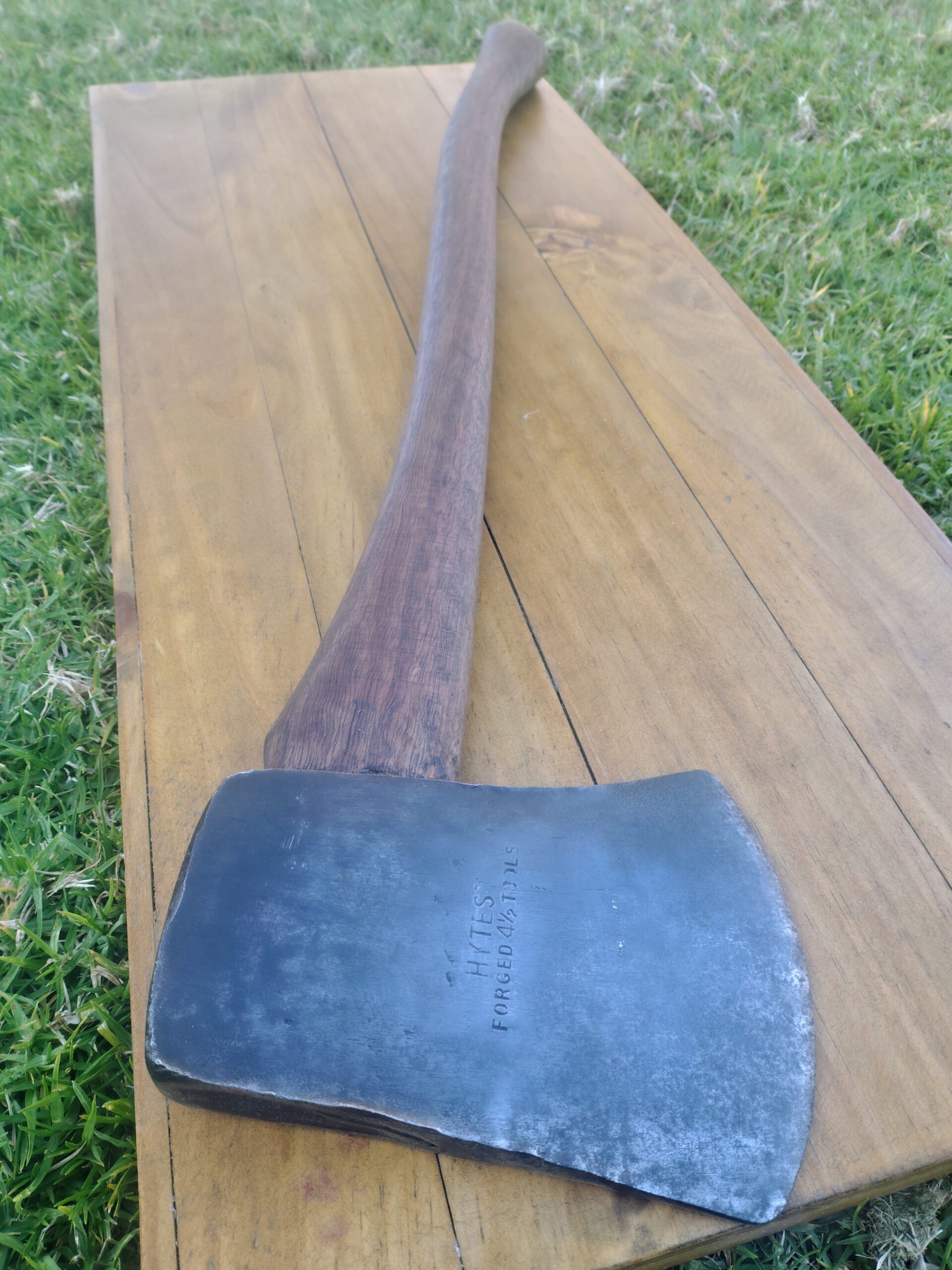
An honest Australian working axe from the 1960s, complete with its original hardwood handle and traces of factory green paint.
This Hytest Forged Tools round poll recently arrived on the Forgotten Steel workbench carrying exactly the sort of wear I like to see on an old Australian axe.
Not abuse.
Not neglect.
Just the quiet signs of a tool that has spent most of its life hanging in a shed waiting for the next load of firewood.
At first glance it would be easy to overlook. The famous red-painted Hytest Tasmanian patterns tend to attract all the attention, while the green utility axes were the dependable farm tools that simply got on with the job. Yet these round poll Hytests were once found on properties all over Australia and are becoming increasingly difficult to find in such honest condition.
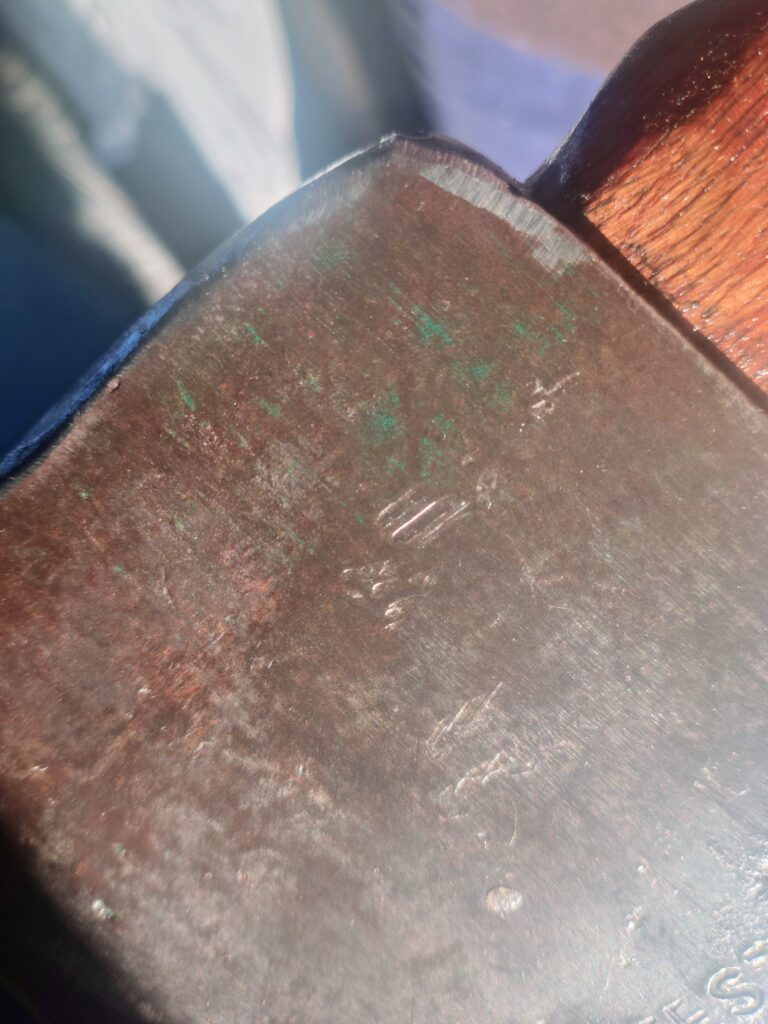
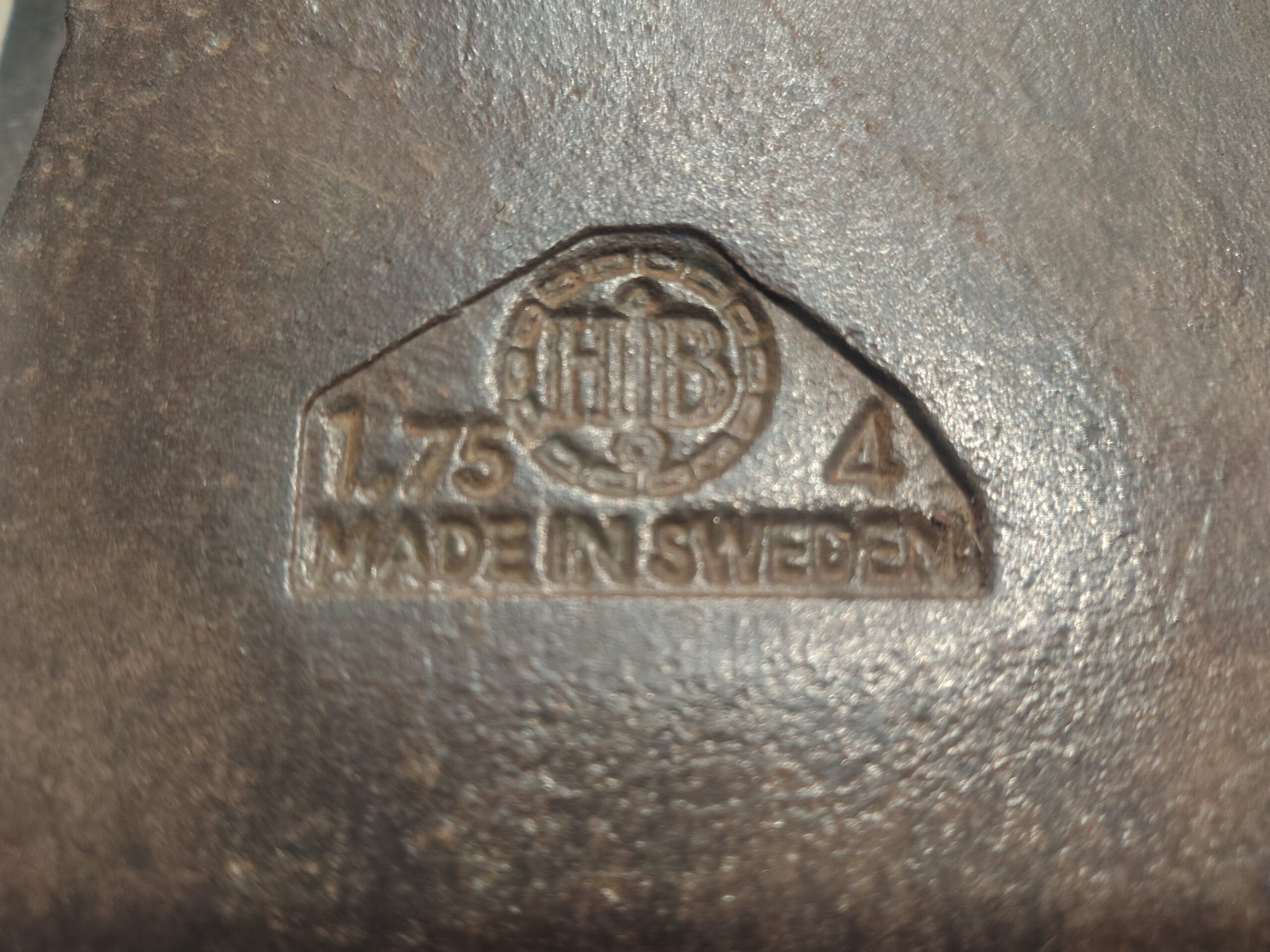
The head still retains traces of its original green enamel, the stamp remains clear and surprisingly deep, and the original hardwood handle is still doing its job more than half a century later.
This is exactly the sort of axe I enjoy restoring.
THE FIND
This axe came to me complete and remarkably original. The previous owner had clearly looked after it, or perhaps more accurately, had never really mistreated it in the first place.
What caught my eye immediately was the surviving green paint. It sits down in the protected areas of the head and along the edges where years of handling haven’t worn it away. Those little remnants are important. Once stripped, they can never be replaced, and they tell us something about the axe’s history.
The other pleasant surprise was the handle. It appears to be the original Australian hardwood handle and has survived exceptionally well, showing only light checking at the toe. The checking is cosmetic rather than structural and does not affect the axe’s usability at this stage.
Most importantly, the axe still feels like an axe rather than a restoration project.
A LITTLE HISTORY
Hytest was one of Australia’s major edge-tool manufacturers during the twentieth century, producing axes, hammers, picks and other forged tools for farms, forestry work and industry.
The HYTEST FORGED TOOLS stamp on this example is characteristic of post-war production, and the surviving green enamel strongly suggests a mid-century Australian-made axe. Based on the stamp style, finish and overall construction, I would date this example to approximately the 1960s.
These were practical tools, not prestige pieces. They were sold to be used, sharpened, hung back on a nail in the shed and used again the following season. The fact that this one has survived with such a good stamp and so little poll damage makes it a particularly nice survivor from that era.
INITIAL ASSESSMENT
The head is in very good overall condition.
The cutting edge shows little wear and retains plenty of original steel. There is no significant damage to the bit and no evidence of major repairs. The poll is especially pleasing, with only very slight mushrooming along the upper edges and none of the heavy hammer abuse so commonly seen on old farm axes.
The maker’s stamp is another highlight. I would rate it roughly 7 out of 10 for clarity and depth, which is excellent for a working axe of this age.
The handle remains tight and serviceable. Apart from the minor checking at the bottom, there is no obvious movement or structural concern.
In short, this axe does not need rescuing.
It needs preserving.
THE RESTORATION PLAN
With an axe like this, restraint is the hardest part of the job.
There will be no aggressive grinding, no mirror polish and no attempt to make it look like a modern reproduction. The goal is to conserve as much originality as possible while returning the axe to reliable working condition.
The planned work is straightforward:
- Gentle cleaning of the head to remove dirt and active oxidation.
- Preservation of the surviving green paint.
- Dressing of the slight mushrooming on the poll with a file.
- Refinement and sharpening of the cutting edge.
- Light sanding of the handle only where necessary.
- Treatment with Forgotten Steel Workshop Oil followed by Forgotten Steel Workshop Wax.
By the end of the process, I want it to look like a well-cared-for 1960s farm axe, not a newly manufactured axe pretending to be old.
WHY THIS ONE MATTERS
There is a temptation in tool restoration to chase perfection. Bright steel photographs well, and a mirror-polished head certainly catches the light. But not every old tool should be polished into submission.
This Hytest still carries evidence of the factory finish, decades of storage and the hands that once used it. Those details are part of its value. They connect it to Australian workshops and wood sheds long before cordless tools and hydraulic splitters became common.
I suspect this axe spent far more time waiting for work than doing it.
That may be why it has survived so well.
And that is precisely why it deserves a careful restoration rather than a dramatic makeover.
CLEANING & HANDLE WORK
Workshop update coming soon.
The next stage will be the gentle cleaning of the head, preservation of the remaining green enamel and the first treatment of the original hardwood handle with Forgotten Steel Workshop Oil.
Sometimes the best restoration is the one that leaves the least evidence behind.
This article will be updated as the work progresses.
Restore it. Use it. Pass it on.