

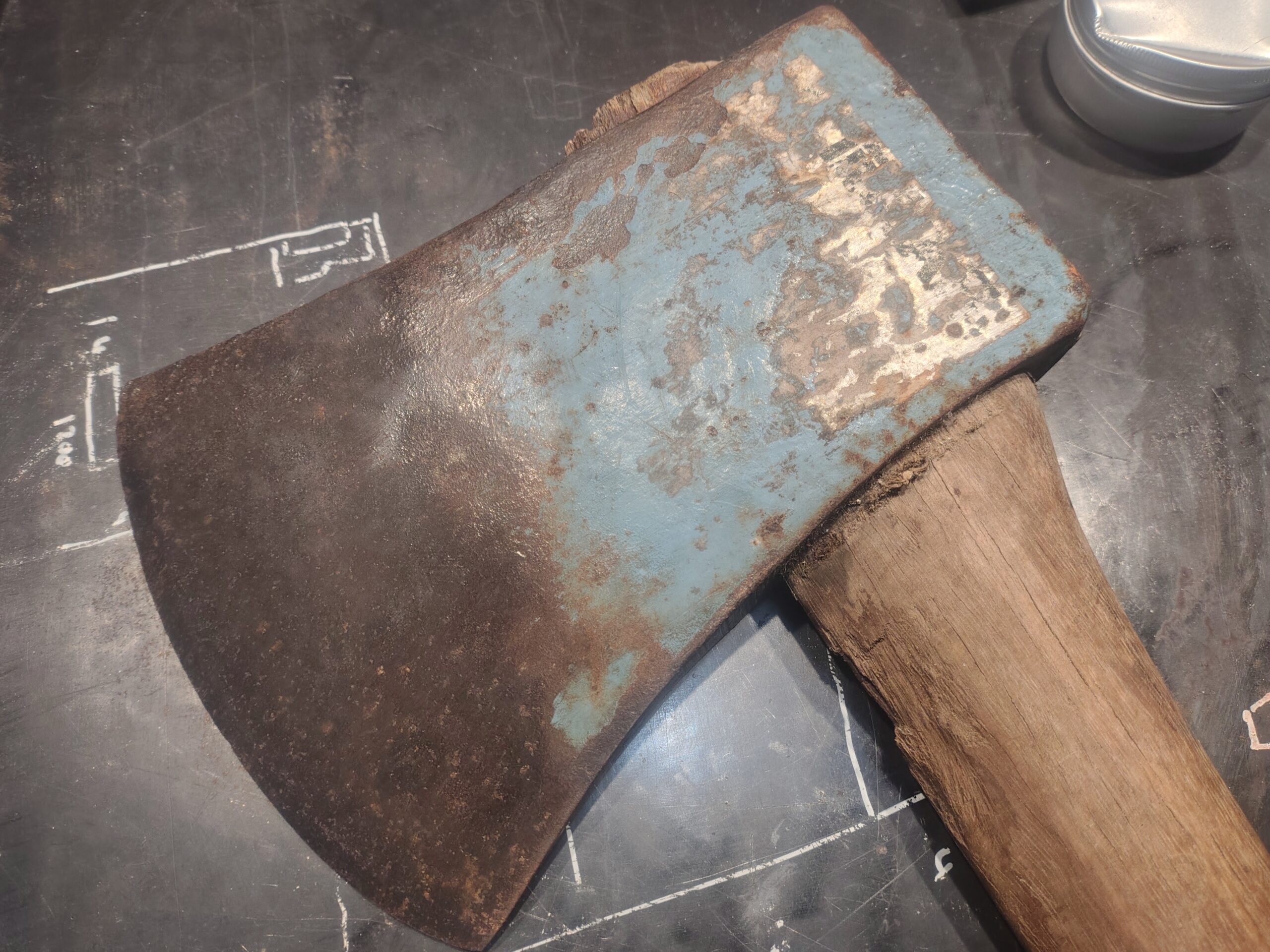
Original paint, a partially surviving paper label and the sort of honest Australian working axe that rarely turns up untouched.
Some finds are exciting because of the maker.
Others are exciting because they have survived against the odds.
This Trojan paper label axe is firmly in the second category.
I picked it up during a visit to Ron’s shed after months of promising I’d come down and look through the rest of his collection. When he sent me a photo beforehand, this was the axe that immediately grabbed my attention. Original paper labels on working axes are uncommon enough; finding one that still retains both its label and a substantial amount of original paint is the sort of thing that makes you start checking the calendar to see whether you’ve accidentally travelled back in time.
The label is worn, fragile and incomplete.
Which is exactly why I love it.
THE FIND
Ron had originally contacted me through a Marketplace ad I placed looking for old axes and tools. What began as a simple enquiry eventually turned into an afternoon spent talking axes, Australian makers and forgotten production variations for well over an hour.
Among the many interesting pieces he showed me, this Trojan stood out immediately. The faded blue paint, the remnants of the paper label and the generally untouched condition suggested an axe that had somehow escaped the usual cycle of hard farm use, repainting and aggressive cleaning.
It wasn’t pristine.
It was original.
And in the world of vintage axes, originality is often far more interesting than perfection.
INITIAL ASSESSMENT
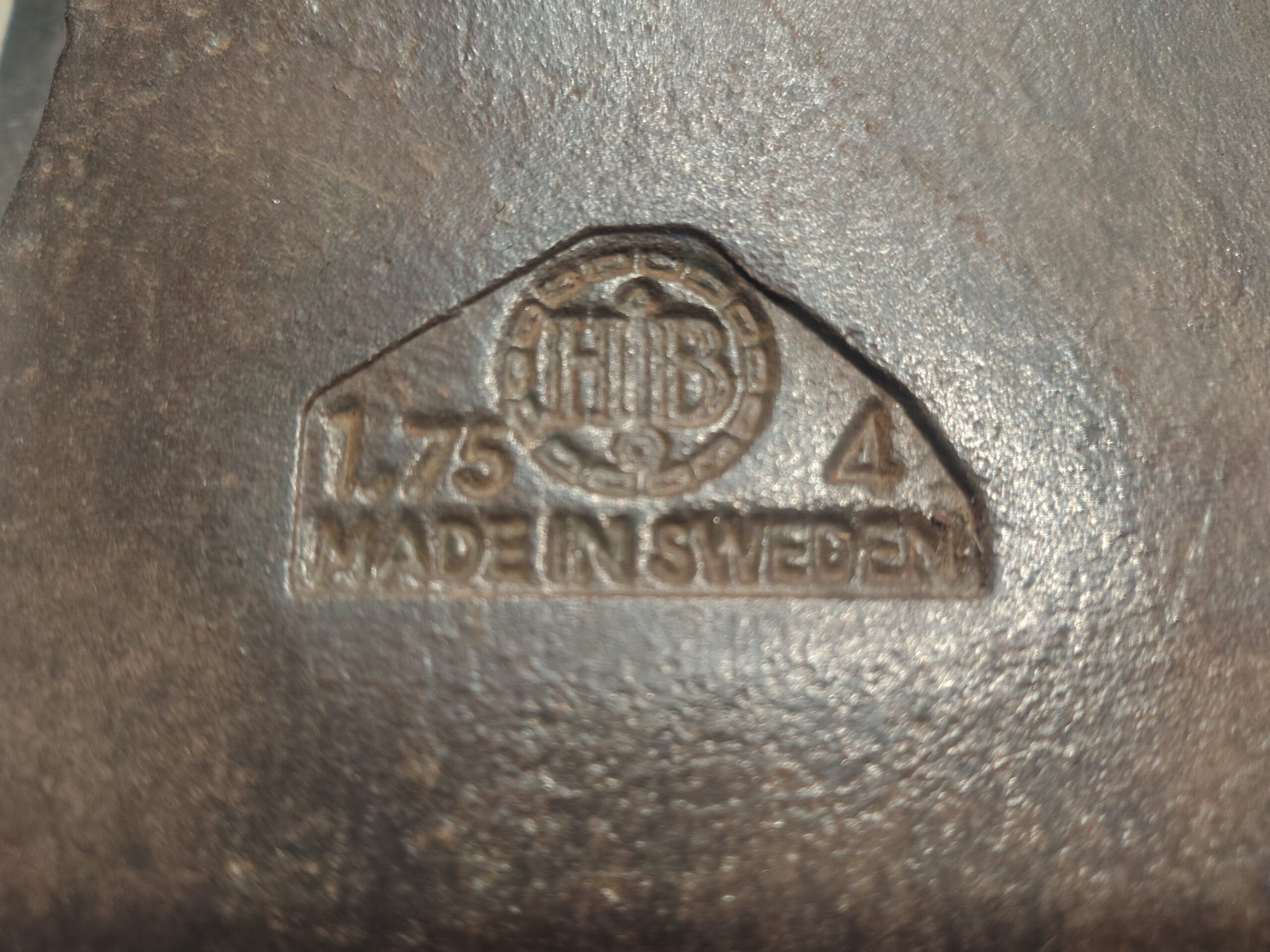
The head remains remarkably honest. A substantial amount of the original blue paint survives across the cheeks, and the paper label is still partially present near the poll. The label is too worn to read clearly in full, but enough remains to confirm its identity and make preservation a priority.
The steel shows surface rust and age-related staining, particularly toward the bit, but nothing immediately suggests serious structural damage. The cutting edge appears to retain plenty of good steel, and there is no obvious evidence of major grinding or reshaping.
The handle is another pleasant surprise. It appears to be an older hardwood handle and remains solidly seated in the eye. There is some checking and weathering, particularly around the shoulder area, but at this stage it remains serviceable and tells part of the axe’s story. Further inspection will be required to see if I want to try undertake repair of the handle or to re-hang the head on a new one to put this axe back to work.
Most importantly, the axe still feels untouched.
That is becoming increasingly rare.
A LITTLE HISTORY
Trojan axes were once common working tools across rural Australia, sold through hardware stores and agricultural suppliers for everything from firewood cutting to general farm work. While they were not marketed as premium collector pieces, they were dependable Australian working axes designed to earn their keep.
Paper labels were never intended to survive for decades. Exposure to weather, handling, oil and sharpening usually saw them disappear quickly, which is why surviving examples are so desirable today. Even partial labels can provide valuable clues about branding, distribution and production periods.
This axe is a reminder that everyday working tools can become historical artefacts simply because so few survive in original condition.
Ron did have the original label off the handle preserved in-between two pieces of cardboard, but I told him that collecting was not my passion, and that stamps and labels were not the most important thing to me, rather just quality steel that can be swung once again. So I suggested he hold onto that label in case he wanted to use it on one of his own personal collections.
THE RESTORATION PLAN
With an axe like this, the greatest danger is enthusiasm.
The goal is not to make it look new.
The goal is to preserve what has survived while ensuring it remains a safe, usable working axe.
The planned work is deliberately conservative:
- Gentle cleaning of loose dirt and active rust.
- Stabilisation and preservation of the surviving paper label.
- Preservation of the original blue paint wherever possible.
- Light dressing and sharpening of the edge without unnecessary steel removal.
- Careful cleaning of the handle followed by treatment with Forgotten Steel Workshop Oil and a protective coat of Workshop Wax or the making of a new one and re-hanging it.
There will be no sanding of the label area, no wire wheel across the painted cheeks and no attempt to strip the head back to bright steel.
Once the label is gone, it is gone forever.
WHY THIS ONE MATTERS
I restore a lot of axes, and many of them are chosen because they have the potential to become excellent users. This Trojan is slightly different.
Yes, it will be sharpened and maintained as a functional axe, but its real appeal lies in the survival of those fragile factory details that almost never make it this far. The worn label, faded paint and aged handle connect it directly to the day it left the hardware store shelf.
Some restorations are about transformation.
This one is about restraint.
If I do my job properly, the finished axe should look less like a restored tool and more like a well-cared-for survivor that has simply been given a little help for the next chapter of its life.
CLEANING & LABEL PRESERVATION
Workshop update coming soon.
The first stage will be carefully cleaning the head and assessing the condition of the paper label before any further work begins. Preserving that surviving label will be the single most important part of this restoration.
Sometimes the smallest piece of paper tells the biggest story.
This article will be updated as the work progresses.
Restore it. Use it. Pass it on.