

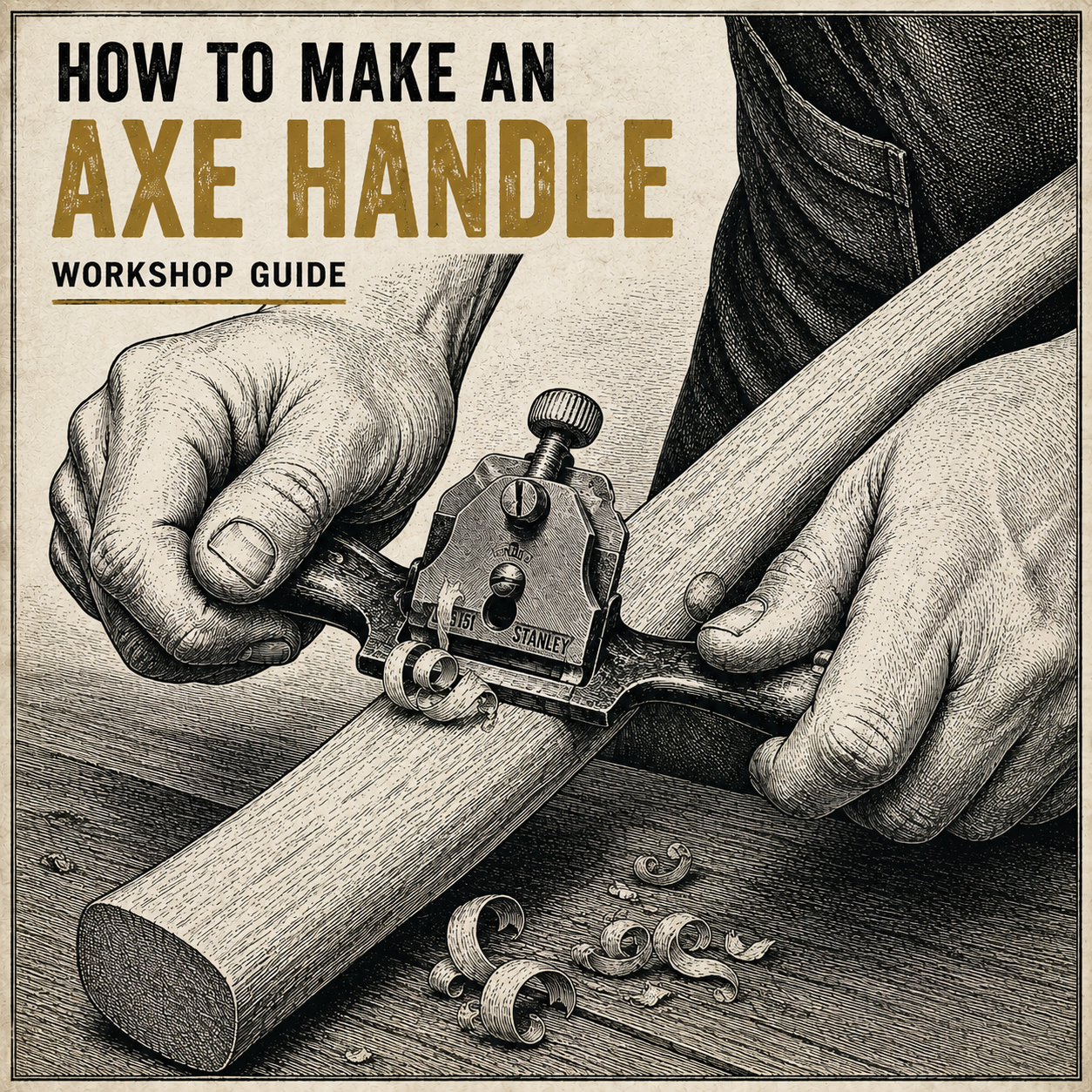
FORGOTTEN STEEL WORKSHOP – Restoration Guide
Why Make Your Own Handle?
There is a particular satisfaction that comes from swinging an axe on a handle you made with your own hands.
It is the same feeling you get from sharpening a chisel until it quietly shaves end grain or bringing an old plane back to life. The tool stops being something you bought and becomes something you understand.
Making your own handle is not always cheaper than buying a factory handle. In fact, once you count your time, sandpaper, rasps and the inevitable cup of tea consumed while staring at grain lines, it is probably more expensive. But that misses the point entirely.
The real value is in the skill.
You learn how wood behaves, how grain orientation affects strength and how small changes in thickness alter the feel of an axe in the hand. After making a few handles, you will never look at a hardware-store handle the same way again.
There is also the enjoyment. A quiet evening in the workshop with a rasp and a timber blank is surprisingly therapeutic. No batteries, no notifications, just the smell of fresh timber and the slow emergence of a handle from a rough block of wood.
Most importantly, a handmade handle can be tailored to you. Factory handles are designed for the average user. You are probably not average. You might prefer a slimmer throat, a larger palm swell, a slightly longer handle or a shape that better suits your grip. A custom handle allows an old axe to feel like it was made specifically for your hand.
And if you make a mistake? Congratulations—you have officially joined a very long tradition of woodworkers who have made kindling by accident.
Choosing the Right Timber
A good handle begins with good timber. For the purposes of this guide, I will focus on the species I use most often in the Forgotten Steel workshop rather than every timber that has ever been turned into an axe handle.
The ideal handle timber is tough, springy, resistant to shock and has straight, uninterrupted grain.
Spotted Gum
If I had to choose one Australian timber for a hard-working axe handle, spotted gum would be very close to the top of the list.
It is exceptionally strong, dense and resistant to impact, which is why it has been used for everything from tool handles to bridge timbers. A well-selected piece of spotted gum makes a superb handle for felling axes, splitting axes and heavy workshop tools.
The downside is that it can be harder on your tools than imported hickory, so keep your rasps sharp and be prepared for a little more effort during shaping.
Ironbark
Ironbark is another excellent Australian option when maximum durability is required. It is incredibly tough and wears extremely well. For large working axes and tools that see hard service, ironbark is difficult to fault.
Its density, however, means it produces a slightly heavier handle and requires more work to shape cleanly.
Tasmanian Oak
Despite the name, Tasmanian oak is actually a group of eucalyptus species. Good straight-grained stock can make a pleasant handle with a slightly lighter feel than spotted gum or ironbark. It is easier to shape and finish and is a good choice for smaller axes and hatchets.
Hickory
Ask a traditional American axe maker what timber to use and the answer is usually hickory.
There is a reason for that reputation. Hickory combines excellent shock resistance with a lively, forgiving feel in the hand. It absorbs impact beautifully and is relatively easy to shape with hand tools. Quality hickory can be harder to source in Australia, but when you find good stock, it remains one of the benchmark handle timbers.
Ash
Ash has been used for tool handles for centuries and offers a nice balance between strength, flexibility and weight. It is generally lighter than spotted gum and ironbark and has a comfortable, slightly springy feel that many users enjoy, particularly on smaller working axes.
What I Reach For Most Often
In the Forgotten Steel workshop, I tend to choose:
- Spotted gum for most full-size working axes.
- Ironbark for heavy-duty tools where toughness is the priority.
- Tasmanian oak for lighter axes and hatchets.
- Hickory whenever I have a particularly nice imported blank.
- Ash for lighter, lively-feeling handles.
Whatever species you choose, the single most important factor is not the name of the timber—it is the grain. Straight grain running cleanly from eye to toe is worth more than any fashionable timber with wild figure.
In the next part of this guide, we will look at grain orientation, selecting a blank and laying out your handle pattern before a single shaving is removed from the timber.
Restore it. Use it. Pass it on.